
Electrophysiological diagnostics of sarcopenia. A case report.
DOI:
https://doi.org/10.36210/bermedj.v1i1.53Abstract
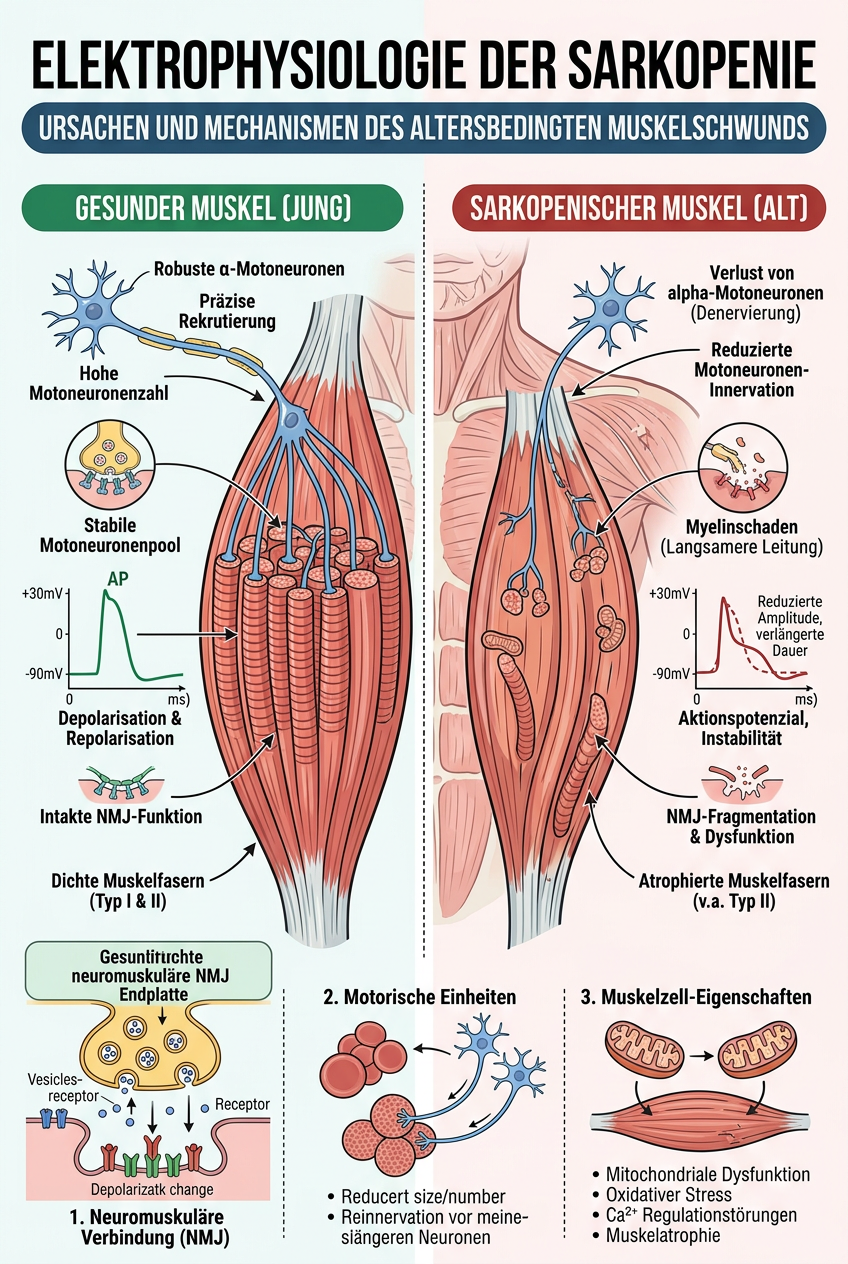
Sarcopenia plays a crucial role in the rehabilitation treatment process for intensive care unit-acquired weakness (ICUAW) caused by immobilization and ischemic-hypoxia-triggered capillary depletion. Clinically, this is characterized by a decrease in muscle mass and strength, which is caused by the loss of type II muscle fibers, a reduction in satellite cells, and collagen incorporation into the muscles. The quantification of sarcopenia presents a clinical challenge for the diagnosis of ICUAW-mediated diseases, such as critical illness polymyopathy (CIM) and critical illness polyneuropathy (CIP), which can be addressed using sensitive neurophysiological parameters. We examined a 66-year-old patient with ICUAW-associated immobilization sarcopenia by determining rheobase, chronaxie, and accommodation threshold under EMG control after 101 days of intensive care treatment. At rest, the EMG values recorded were an average frequency of 53 Hz, an RMS of 4.6 µV, an MVC of 51 µV, and an iEMG of 243 µV*s, indicating lower intrinsic muscular activity. The rheobase was 7 µV, the chronaxie by 12.5 ms, and the accommodation threshold by 7 mA above the normal range. The accommodation quotient was 0.4 below the normal range. The stimulation-induced muscle potentials averaged an RMS of 602.5 µV, an MVC of 2761.2 µV, and an iEMG of 528.7 µV*s. The results suggest that in the case of sarcopenia acquired through immobilization, additional components of neuromuscular dysfunction must be assumed in the combination of the determined values, since in the differential diagnostic approach to ICUAW-associated symptoms, in addition to reliable indications of muscle atrophy, important aspects in the weighting and therapy stratification were also conveyed, as signs of neuro- and myodegenerative functional changes.
Published
How to Cite
Issue
Section
License
Copyright (c) 2026 Olaf Schedler; Wolfgang Laube, Michael Adamaszek,

This work is licensed under a Creative Commons Attribution-NonCommercial-NoDerivatives 4.0 International License.


